

Hasties Swamp monthly bird survey: November 2025

Lesley Deacon | Guest Contributor
What a beautiful morning and great birding we had for the November 2025 survey. Late spring is by far the most agreeable time to be birding at Hasties. There was clear, warm weather and with water levels continuing to recede there were waders aplenty.
Conditions were also favourable for the bush birds and there were many birds and various juveniles chasing after parents for food, and just not learning yet how to be unobtrusive. 68 different species were recorded for the morning. This time last year we recorded the highest number of species ever with 75, but 68 is still a very high number.
We spent much more time than usual in the hide as we scanned the far bank for waders, and were rewarded by finding two Sharp-tailed Sandpipers feeding at the water’s edge. Groups of Royal Spoonbill progressed along the water’s edge in precision. As they moved to a new area, they were quickly followed by the Egrets which took advantage of the Spoonbills stirring up food as they sifted through the mud.
There were at least two White-necked Heron, which are usually uncommon here: the fish and crustacean numbers must be high. It was fascinating to watch a group of Little Black Cormorant fishing in tandem with the Australian Pelican. A ‘family’ group of Sarus Crane was feeding on the far bank. When the birds took flight however, we could see there was actually only one juvenile bird. Someone suggested it can be common for a lone adult bird to attach itself to a small family.

It was tough work to find some Hardhead. They disappear as soon as the water gets a bit shallow. All the Plumed Whistling-Duck have dispersed, but there were still groups of Wandering Whistling-Duck on the water.

There were good numbers of Eurasian Coot and Australasian Grebe, and the strange rising “gnow” call alerted us to a group of Australian Wood Duck.
The plaintive call of Peaceful Dove could be heard from afar. The call has been described as “coo-a-luk” or “doodle-doo”, and someone once told me it is “eyes are blue”, because they are….blue. One of our number insists it is easier to hear “it’s horrible”. So for the rest of the morning we heard the “horrible, horrible” calling from the treetops. You might ask what the Peaceful Dove finds horrible. In fact, nearly all the Doves have calls that are a response to questions about public transport. The Bar-shouldered Dove says “I walked of course”, and the Brown Cuckoo-Dove repeatedly asks “Did you walk?”. (Listen carefully and see if you can hear it. I have many more. Ask me one day.)

We had a small joke about recording a Little Shrike-thrush for the first time. The most recent taxonomic changes have had this little bird change nomenclature from Rufous Shrike-thrush back to Little Shrike-thrush, which it had originally been named before a change only a few years ago. Our local bird, which is a year-long resident at Hasties Swamp, is definitely much more rufous than the birds found further south. We shall try to remember it now has a different name. eBird adds to the confusion by listing it as Little Shrike-thrush (Rufous).

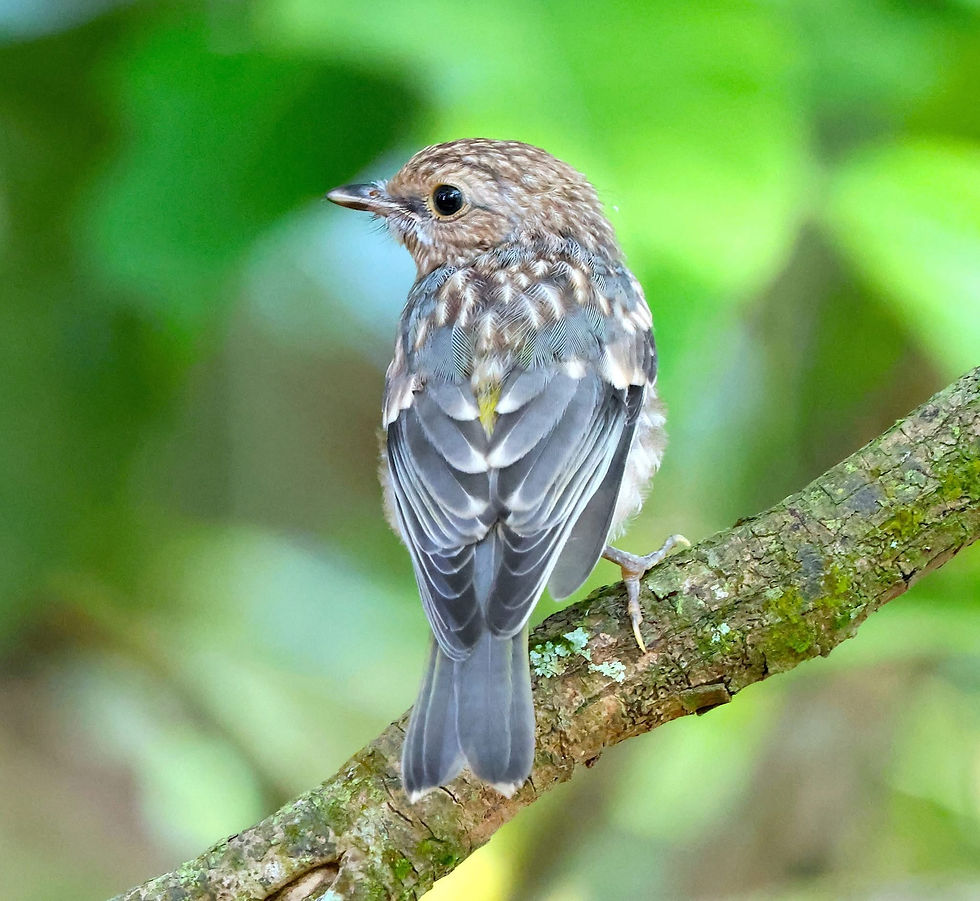
There were lots of bush birds busy foraging and nest building. The largest total of bush birds belonged to the Brown Gerygone who twittered and fluttered everywhere in the canopy. It is a real treat if you get a good view of them sitting still. Careful observation should show more than one of the beautiful hanging nests dangling from high foliage. Many Silvereye were also busy feeding and shrilly chirping. The Eastern Yellow Robin have already produced one lot of fledglings.
It was our first sightings of the season too for the migratory Dollarbird, Pacific Koel, and Tree Martin.
We look forward to following the abundance of birds at this time of year at the Hasties Swamp National Park, Tropical North Queensland.


