

Recent literature about north Queensland birds – June 2026

Compiled by Don Franklin | Guest Contributor
Tooth-billed Bowerbirds
A 2025 special issue of Emu provides rich pickings for this Recent Literature, including two perspectives on the unusual mating behaviour of the Tooth-billed Bowerbird and one about the impact of tropical cyclones on the species’ abundance.
“The Tooth-billed Bowerbird (Scenopoeetes dentirostris) is unique among the polygynous bowerbird species because males form exploded lek aggregations, do not build any structure on their courts, and have almost continuous loud vocal displays throughout the day. We show that Tooth-bills differ from other bowerbirds by having unusually brief courtships, with females landing on courts already in a preliminary receptive position. Males then aggressively capture and copulate with visiting females, limiting female opportunity for mate assessment of on-court displays. Despite this, we found high variance in male mating success, with males at lek centres having the highest number of copulations. These results suggest that the position on leks allow for female assessment of male quality” (Borgia et al. 2025).
“Solicitation, apparent insemination and subsequent prolonged vigorous mounting by male Tooth-billed Bowerbirds are described from automatic video camera recordings set at ground display courts. Prolonged and persistent, post-cloacal contact, mounting by the male grasping the female by her nape to then repeatedly violently tumble and roll together for extended periods with loud male vocalisations is documented” (Frith & Freeman 2025).
“We monitored three groups of courts on the Atherton Tablelands, Queensland, for 15 years after TC Larry (2006) and TC Yasi (2011) which damaged the surrounding forest. Court numbers fell sharply after TC Larry, remained depressed following TC Yasi, and persisted at 50–60% of pre-Larry levels for over a decade. Recovery of court numbers began only after 10–12 years, reaching 86% of pre-Larry numbers across the three groups by 2020” (Freeman & Harrington 2025).

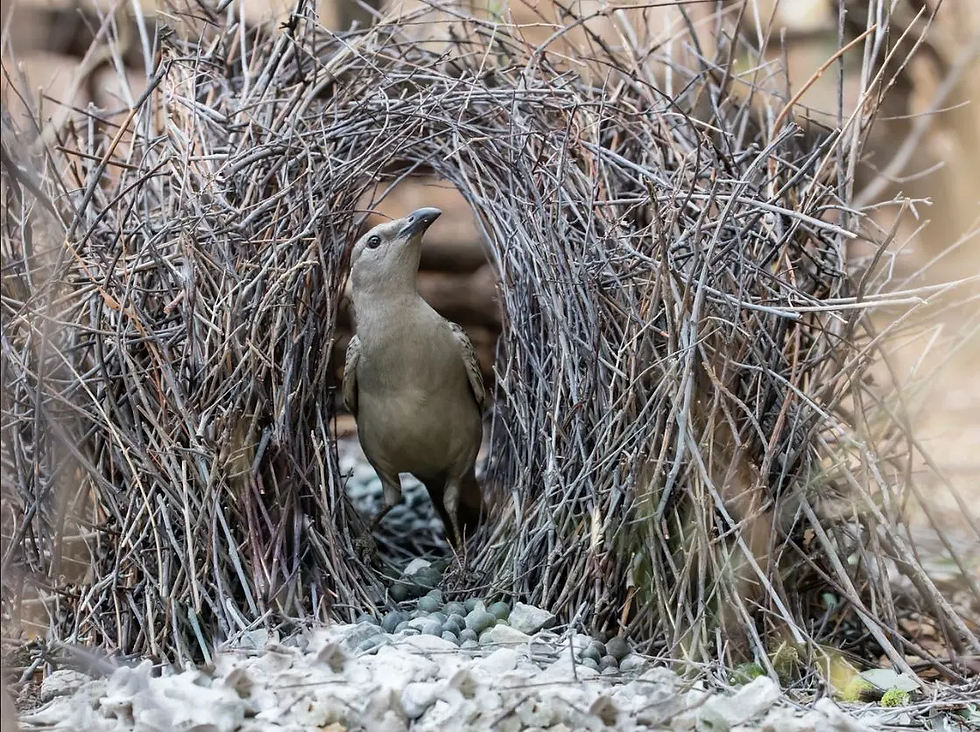
Great Bowerbirds at their bowers
The special issue also provided the opportunity for three fascinating perspectives on bowers, bower decorations and displays of the Great Bowerbird.
“We examined whether male Great Bowerbirds (Ptilonorhynchus [= Chlamydera] nuchalis) prefer to steal certain colours, types or sizes of decorations; and how stolen decorations are sourced from, and placed on, bowers. Males were more likely to steal green and red decorations than grey ones. Among 44 decoration types, males stole only red wire and green plastic more frequently than expected by chance. Stolen red wire was shorter and lighter than non-stolen red wire. For both red wire and green plastic, stolen objects had higher chroma than non-stolen objects. Males were more likely to place stolen decorations in the avenue or hanging on the bower walls than on the courts, sides, or periphery, and they were more likely to steal decorations from within the avenue. Through theft of colourful decorations, some of which are lighter and smaller, thieves may increase the visual contrast or attractiveness at their bowers while reducing the costs of transport. Placement of decorations in specific locations such as the avenue may help females quickly assess the competitive ability of the male” (Doerr & Endler 2025).
“Over 2 years, we measured the number of bower decorations, the length and spectral properties of male nuchal crests, circulating testosterone (T-levels) and quantified male displays when solitary (Display Rate, year 1) or with a visitor present (Courtship Rate, year 2). We found that crest-length and luminance, and several decoration types, predicted T-levels in both years. Some decoration types predicted both T-levels and crest-length, but other decoration types predicted crest-length but not T-levels. Decorations that predicted Display Rate or Courtship Rate were independent of those predicting T-levels and crest characteristics. Thus, females could use different classes of bower decorations to assess male behaviour, morphology and endocrine status, with some signals being redundant and others serving as independent signals of male qualities” (Day et al. 2025).
“We examined how court appearance in terms of overall court luminance and within-court contrast varied with the local light environment, using canopy cover above the bower as a proxy. We tested whether court appearance was limited by the availability of objects in the environment by supplementing bowers with dark and light court objects to offer a range of contrast levels. We also manipulated canopy cover to test whether males adjusted court appearance in response to a change in the light environment. Courts under naturally higher canopy cover had lower luminance and contrast than those under more open canopies. When provided with additional objects, all males increased court luminance and contrast, regardless of canopy cover. These findings suggest males enhance contrast when not constrained by object availability, but do not consistently fine-tune court appearance based on ambient light” (Van Berkel et al. 2025).
Kookaburra species interacting positively
“An unsexed adult Laughing Kookaburra Dacelo novaeguineae and an adult male-plumaged Blue-winged Kookaburra D. leachii were observed and photographed as they repeatedly examined, and separately spent periods of time within, a potential nesting tree hollow on Magnetic Island, north Queensland, in August 2025. The Laughing Kookaburra repeatedly mated with the Blue-winged Kookaburra in an adjacent tree. Associated with them were at least another male and two female Blue-winged Kookaburras” (Frith & Addington 2025). And in follow up: “A Laughing Kookaburra Dacelo novaeguineae, previously reported to have repeatedly inspected a potential nest hollow and mated with an adult male Blue-winged Kookaburra D. leachii on Magnetic Island, north Queensland, in August 2025, was photographed feeding a brood of two juvenile Blue-winged Kookaburras at the same location in late December 2025” (Frith et al. 2026).

Threatened parrots and cockatoos
The argument about woody encroachment, nest predation and the fate of the Golden-shouldered Parrot has long been made, but rarely formally evaluated; now it has been. “The parrots preferentially nested in areas of low woody vegetation density. In contrast to previous work, we found that encroachment increased the probability of predation, and reduced nest success and survival of nesting adults. Encroachment both drove a decline in fire frequency and was exacerbated by it. The parrots have abandoned areas where encroachment has been most advanced” (Crowley et al. 2025).
“This study used an occupancy modelling approach to examine landscape-scale ecological factors influencing palm cockatoo presence across ~3000 km2 within the Weipa Plateau, Cape York Peninsula, Australia. To determine palm cockatoo occupancy, 421 surveys were conducted at 142 sites in June–July 2024. Palm cockatoos were detected on 41 occasions across 34 sites. ... Occupancy modelling identified distance from major watercourses and the density of a major food source, nonda plum (Parinari nonda), as the strongest predictors of palm cockatoo occupancy. ... it highlights the urgent need to conserve habitat along riparian corridors and areas of high-resource availability in adjacent savanna woodlands to protect the current palm cockatoo population from further decline.” (O’Neill et al. 2026).

Bird surveys
“On the Atherton Tablelands, bird lists were compiled in 96% of the months from 1992 to 2009, on a ~16 ha farm bordering disturbed tropical rainforest. Cattle were excluded from ~3.4 ha, including patches of regrowth that were ~40–70 years old in 1988 and rainforest plantings. The site was separated by a narrow road from the southern end of the 1.7 km Lakes Corridor, linking two ~500 ha rainforest remnants of Crater Lakes National Park. Of 125 bird species recorded in >10 monthly lists (comprising 16,260 records), 50 species (40%) were typical of intact rainforest in the area, including 21 Wet Tropics endemic species or sub-species and 12 species able to disperse seeds of large fruits, essential for rainforest regeneration. Total records of non-rainforest species decreased significantly over time, and the reporting rates of 13 rainforest-dependent species increased” (Scambler 2025).
Tng et al. (2024) documented the flora and fauna of “an eight hectare (21 acre) privately-owned Mabi forest remnant in East Barron”. Combining records from the Atlas of Living Australia, a previous survey and their survey in March and April 2025, 123 species of birds were recorded. These are enumerated, along with the source of the record, in a supplementary file available from the journal web-site.

Other birds
“During 1978–1990, 1995 and 1997 fieldwork on bowerbirds, 15 Fernwren nests were found opportunistically at various stages of the nesting cycle, and their sites are described. Egg sizes and weights and the long incubation period, parental provisioning rates to nestlings, nestling growth rates, and long nestling period involving data from eight Fernwren nests are presented and discussed” (Frith & Frith 2026).
“A regular foraging interaction between cranes and raptors in grasslands and savannahs of the Gulf Plains, northwestern Queensland, is described. Cranes (both Brolgas Antigone rubicunda and Sarus Cranes A. antigone) foraging for insect prey (largely locusts) in tall grass were frequently followed by raptors (five species observed), which fed on insects disturbed by the cranes” (Grant 2026). The raptors were Black and Whistling Kites (22 observations, often together), Nankeen Kestrel (5 observations), Brown Falcons (3 observations) and Australian Hobby (1 observation).
“I observed dew bathing by five bird species at Koah in north Queensland ... . On two occasions the behaviour was prolonged and social, but there are no consistencies that suggest a general explanation for the behaviour” (Morrison 2025). The species were: Australasian Figbird (2 occasions), Olive-backed Sunbird (4 occasions), Rainbow and Scaly-breasted Lorikeets together (1 occasion), and Silver-crowned Friarbird (1 occasion).

References
Crowley GM, Shephard S, Murphy SA, Garnett ST. 2025. Woody plant encroachment drives the decline of a grassland bird: The fate of golden-shouldered parrot (Psephotellus chrysopterygius) nests. PLoS ONE 20: e0327543. https://journals.plos.org/plosone/article?id=10.1371/journal.pone.0327543
Borgia G, Uy JAC, Billman JAH. 2025. The unique mating system of Tooth-billed Bowerbirds and bower evolution in the maypole-building clade. Emu 125: 372-383.
Day LB, Ewen J, Astheimer LB, Wingfield JC, Endler JA. 2025. Different components of the Great Bowerbird (Chlamydera nuchalis) multimodal signal associate with distinct male traits. Emu 125: 306-320.
Doerr NR, Endler JA. 2025. Decoration theft in the Great Bowerbird: preferences for colour, size and placement at the bower. Emu 125: 417-428.
Freeman AND, Harrington GN. 2025. Courting disaster: loss and long-term recovery of Tooth-billed Bowerbird courts after two tropical cyclones. Emu 125: 334-342.
Frith CB, Addington M-A. 2025. A Laughing Kookaburra and a Blue-winged Kookaburra repeatedly inspecting a nest hollow and mating. Australian Field Ornithology 42: 225–228.
Frith CB, Addington M-A, Willis M. 2026. A Laughing Kookaburra assists in raising Blue-winged Kookaburras’ offspring. Australian Field Ornithology 43: 24-25.
Frith CB, Freeman AND. 2025. Solicitation and extraordinarily prolonged and vigorous mating behaviour by Tooth-billed Bowerbirds Scenopoeetes dentirostris; Ptilonorhynchidae. Emu 125: 384-392.
Frith CB, Frith DW. 2026. Nesting biology of the Wet Tropics endemic Fernwren Oreoscopus gutturalis. Australian Field Ornithology 43: 53-59.
Grant JDA. 2026. A regular commensal foraging interaction between cranes and raptors on the Gulf Plains of north-western Queensland. Australian Field Ornithology 43: 26-28.
Morrison SC. 2025. Observations of birds bathing in dew-laden foliage in Far North Queensland. North Queensland Naturalist 55: 105-108. https://6febe29f-c7a3-447c-8c7a-1bdc521de344.filesusr.com/ugd/003377_5a09fdb015d34749842cb51b9c58b88c.pdf
O'Neill A, Crates R, Drake E, Heinsohn R. 2026. Applying occupancy modelling to inform conservation strategies for a Threatened parrot population. Austral Ecology 51: e70218. https://onlinelibrary.wiley.com/doi/epdf/10.1111/aec.70218
Scambler E. 2025. Changes in the avifauna of disturbed Wet Tropical rainforest, regrowth and pasture at Lake Eacham, Far North Queensland, over 18 years. Sunbird 52: 24-34. https://birdsqueensland.org.au/sunbird_issues/articles/Vol_52/Scambler_2025_v52_1_24-34.pdf
Tng DYP, Carlson EM et al. 2026. A biodiversity survey of a remnant semideciduous forest at East Barron, Atherton Tablelands. North Queensland Naturalist 56: 16-34.
Van Berkel M, Evans C, Thornton A, Kelley LA. 2025. Males maximise luminance and contrast of their display arenas irrespective of local light conditions in Great Bowerbirds Chlamydera nuchalis. Emu 125: 406-416.


