A weekend with the Golden-shouldered Parrots

Stella Martin | Guest Contributor
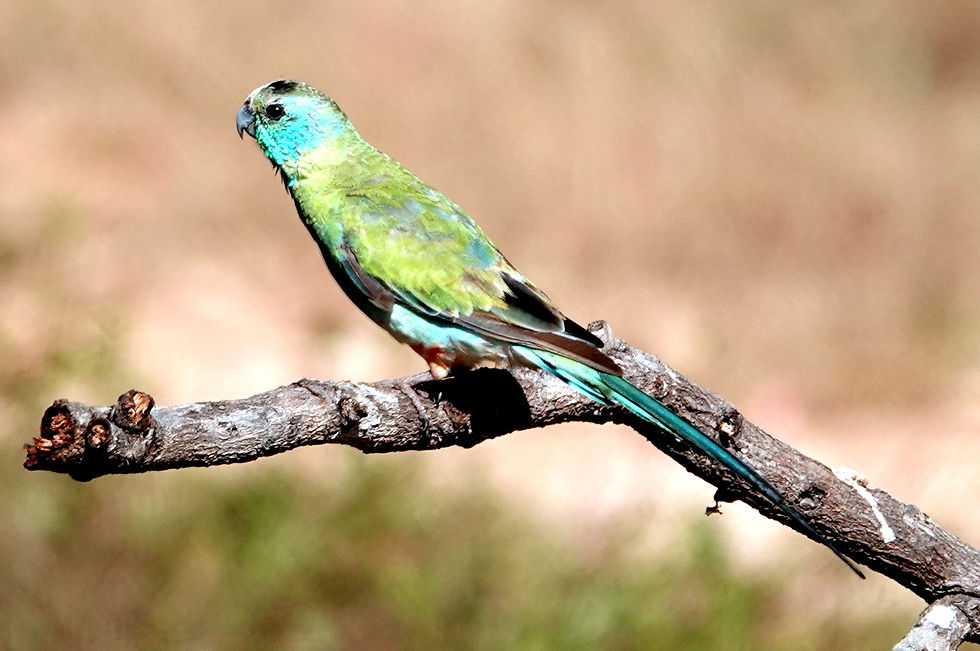
Back in the early 1990s, when I was working at Queensland Parks and Wildlife Service, I got to know Stephen Garnett on one of his trips to Cairns from Cape York’s Artemis Station, where he and his wife Gabriel Crowley were researching Golden-shouldered Parrots. Once widespread across Cape York Peninsula, their range and numbers had shrunk considerably. In 1995, along with my husband, Denis Walls, and our two sons, I visited Stephen and Gabriel at Artemis and encountered these gorgeous parrots for the first time. We helped Stephen search for nest sites, and I was rather chuffed to discover a new one.

Between 15 and 18 May, we revisited Artemis Station and got to see how the parrots were faring 31 years later. And they are doing well! Stephen has long ago moved on, but the station owner, Sue Shepherd, has maintained a close relationship with the parrots, putting in countless hours of surveying and care. She is currently helped by Patrick Webster of Conservation Partnerships who, after searching in vain for the Buff-breasted Buttonquail, has spent seven years at Artemis focussing on the parrots. He was kind enough to escort our group to one of the nests, from which the young had fledged, to explain the latest conservation efforts.
Golden-shouldered Parrots nest in burrows which they dig into termite mounds, principally the conical ‘witches hat’ type but occasionally using magnetic or boulder mounds. The female lays about six eggs. After she has produced three, she is committed to the site and will not desert as her supporters prepare the defences against predators. Nearby trees are felled, grass cut back and an electronic barricade erected. A perimeter wire discourages trampling stock. Closer to the mound a low fence of wires serves to keep goannas away while a surrounding mesh was added after a sneaky Brown Tree-snake managed to loop through the wires. Twenty nesting mounds are being protected in this way and, happily, the survival rate of the parrots has increased from about 35% to about 70%.

Other predators, notably goshawks, butcherbirds and kookaburras, are also blamed for the decline. They tend to attack the parrots outside the nest and have greatly benefitted from ‘woody thickening’ of the habitat, the result of pastoralists abandoning traditional burning regimes in favour of cattle grazing. Hot, late dry season fires which kill tree saplings have given way to lower intensity, early dry season burning, which allows sapling survival. More recently, carbon offset subsidies have benefitted landowners who burn early. By contrast, the Shepherds tended to burn late, a factor thought responsible for the good numbers of parrots on their property. Why? Well, trees provide perches and cover for predators such as butcherbirds.
Nevertheless, despite efforts to control them (poisoning is tricky and deep roots allow those chopped to resprout) tree cover has been increasing around the termite mounds. This has led to an unfortunate local decline in numbers of an important character in the story. Black-faced Woodswallows can function as vital sentinels. At the beginning of the wet season, the parrots, including the fledged young, have to forage on the ground for seeds. At this time the woodswallows are nesting, choosing open areas where they can swoop on insects and keep watch for predators. Higher in the trees, they are the first to spot predatory birds and at once sound the alarm upon which the parrots dash for cover. However, due to the woody thickening, Patrick told us that the woodswallows have disappeared.

Patrick also told us about the tiny moths which share the nest; the adult moth lays its eggs at the same time as the parrot, and the young of both species hatch simultaneously. The caterpillars then feed on the nestlings’ droppings (as well as any that die) keeping the nest clean. They even spin a type of web on which the young parrots can stand. Without the caterpillars, the young parrots might be unable to leave the nest if their legs are too clogged with droppings. The caterpillars eventually pupate near the opening to the nest and emerge in time for the following nesting season. This moth species lives only in Golden-shouldered Parrot nests and without them would become extinct – as happened to the moth which nested with the now extinct Paradise Parrot. A third moth depends entirely on the third mound-nesting species, the Northern Territory’s Hooded Parrot. We didn’t see any of the parrots at the nesting site but were treated to views each day at the feeding stations set up around Artemis.
These stations can attract as many as 30 parrots at the beginning of the wet season when native grass seeds are too wet but germinating plants have not yet set seed. While not so numerous during our visit we were delighted to be able to watch a good number of these gorgeous parrots, including a healthy number of presumed juveniles. We were also happy to contribute to the ongoing efforts to save them.

Editors note: Special thanks to Cairns Birders who organised the visit and the talk by Pat.